

February 10, 2026
Professor Daniel Blankschtein will transition to professor, post-tenure, at the end of the 2025-2026 academic year.
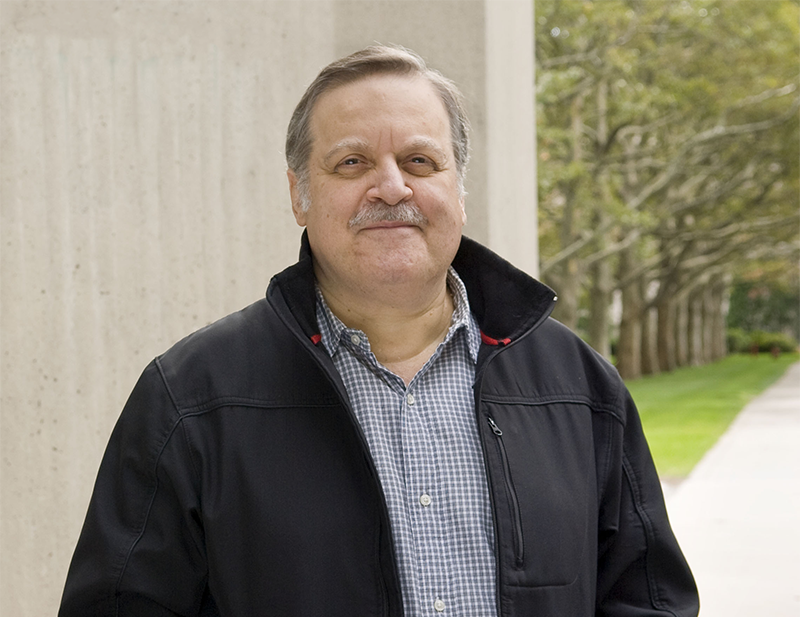 Professor Blankschtein has been an enthusiastic and productive member of the MIT Chemical Engineering faculty for forty years; we are grateful for his contributions to our department and especially to our students.
Blankschtein’s commitment to our students is well-documented. He has been recognized with the annual Course X Graduate Student Council Outstanding Faculty Award (now named the James W. Swan Outstanding Faculty Award) an unprecedented nine times: in 2015, 2011, 2008, 2005, 2002, 2000, 1998, 1993, and 1991. In 2015, he received MIT’s McDonald Award for Excellence in Mentoring and Advising, which “honors those faculty members who, through their lasting commitment to personal and professional development, help maintain the School of Engineering’s leadership in education and research.”
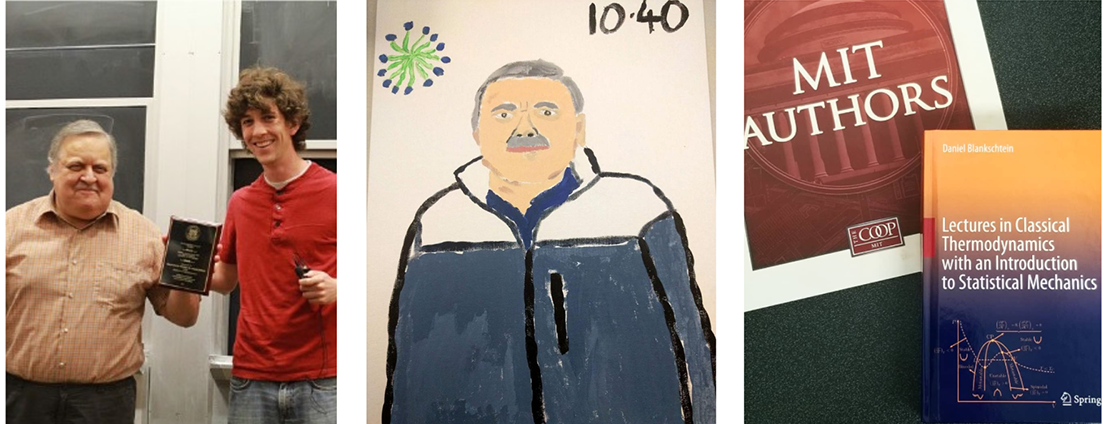
In 2021, Blankschtein published the textbook, Lectures in Classical Thermodynamics with an Introduction to Statistical Mechanics, based on his lecture notes that he refined while teaching graduate-level thermodynamics 16 times over three decades.
Blankschtein began his MIT career in 1986 as an assistant professor and served on several Institute and department committees, including his role as graduate officer for the Department of Chemical Engineering from 2001 to 2006. He earned his BS (1977), MS (1979), and PhD (1983) from Tel-Aviv University. When Blankschtein began his career at MIT his research involved predicting the properties of surfactants, and he has also done theoretical and experimental work aimed at using ultrasound to temporarily open conduits in the skin so that drugs like insulin can be delivered through the skin rather than via injection. His theoretical modeling work identified the necessary conditions for the successful transdermal delivery of many drugs. Blankschtein’s most recent work has been focused on elucidating the importance of many-body effects such as polarization interactions on the thermodynamic and transport properties of electrolytes at solid/water interfaces. Blankschtein’s research has spawned 15 patents and more than 230 research articles, with his work providing new insights into multi-phase thermodynamics at the molecular level. Among his recognitions, Blankschtein earned the Controlled Release Society’s Dow Corning Award (1999), American Pharmaceutical Association’s Ebert Prize (1996), Harvard Health Letter’s Outstanding Research Award (1996) and was an NSF Presidential Young Investigator (1989).
Blankschtein is excited to remain engaged with the department and will continue to serve on the graduate committee as professor, post-tenure. We are grateful for his enthusiasm and passion for education, as well as his accomplishments in the field of colloid and interface science.